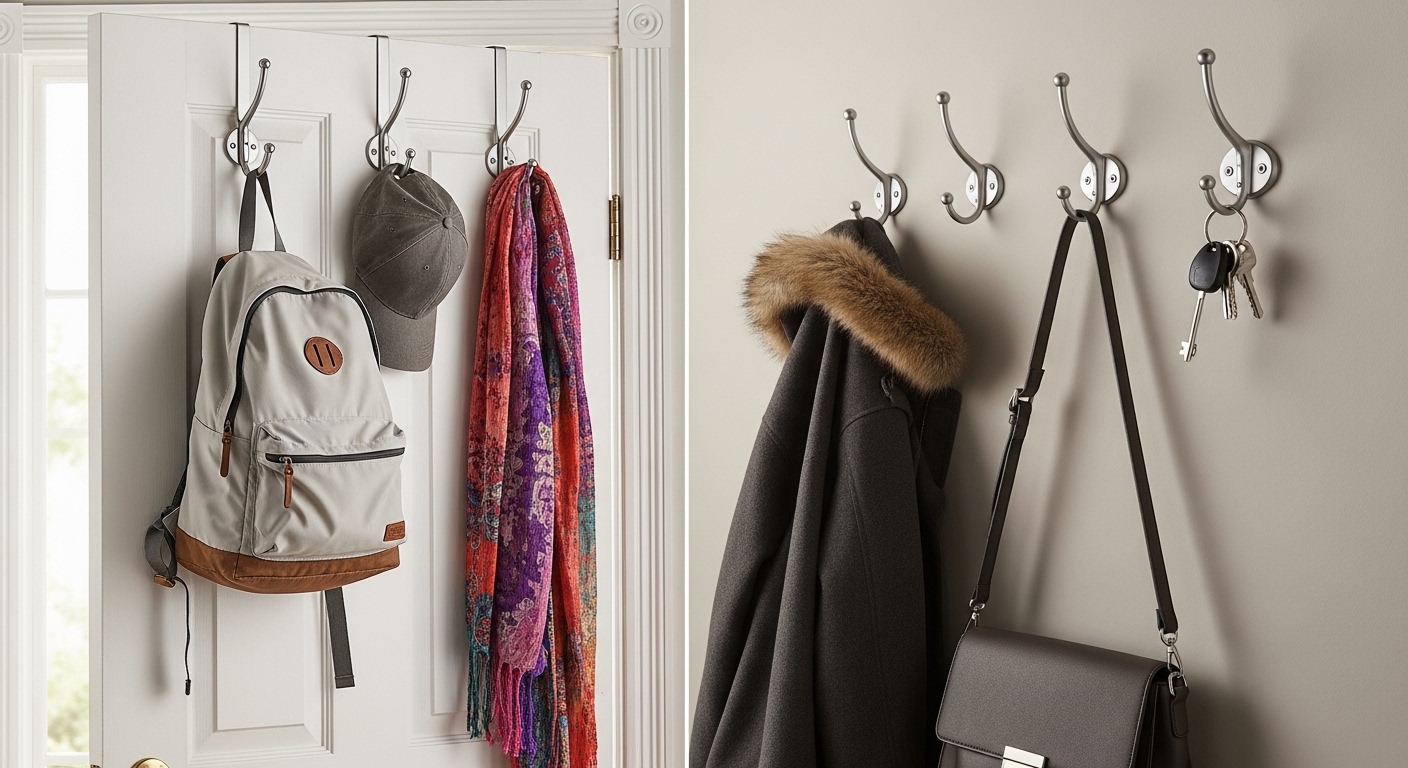
If you’re trying to hang backpacks, coats, towels, or purses without turning your space into clutter, hooks are the fastest fix. But the type of hook matters more than most people think—because the wrong choice can lead to a wobbly door, chipped paint, ripped drywall, or hooks that “mysteriously” fail when you’re rushing out the door.
Below is a practical, SEO-friendly comparison of over-the-door hooks vs wall-mounted hooks—with clear pros/cons, real-life tradeoffs, and the best pick depending on your space.
Quick Answer: Which holds more?
- Most weight (most reliable): Wall-mounted hooks (especially when screwed into studs or quality anchors).
- Most capacity without tools: Over-the-door hooks (great for many items, but depends on door strength and fit).
- Least damage risk (renter-friendly): Over-the-door hooks (if padded and fitted correctly).
- Best long-term “set it and forget it”: Wall-mounted hooks installed properly.
What “holds more” actually means (real-world strength)
Many people assume the hook fails because “it’s weak.” Usually, it’s the mounting point that fails.
Two kinds of stress:
- Downward force (gravity): coats, towels, bags pulling straight down
- Outward/side force (the killer): grabbing a backpack fast, kids yanking, door slamming
Wall-mounted hooks handle outward force better if installed correctly. Over-the-door hooks handle downward force well, but can struggle with side force because the hanger can shift.
Over-the-Door Hooks (Pros & Cons)
✅ Pros
1) No drilling, fast setup
Perfect for renters or anyone who wants instant organization.
2) High capacity for the footprint
Many models offer 5–10 hooks on one hanger, so you can hang multiple coats/bags in a tight space.
3) Easy to move and reconfigure
Great for dorms, apartments, guest rooms, or seasonal needs.
4) Minimal wall damage
If used correctly (and padded), you usually avoid drywall holes or torn paint.
❌ Cons
1) Can damage the door (quietly over time)
Common issues: scratches at the top edge, paint rub marks, dents from metal pressure points.
2) Door might not close smoothly
If the hook is too thick for your door gap, it causes:
- sticking
- latch misalignment
- chipped door frame paint
3) Less stable for heavy, swinging loads
Backpacks can swing when the door moves, creating extra stress and noise.
4) Not ideal for hollow-core doors (for heavy loads)
A lot of interior doors are hollow-core—fine for coats, not great for multiple heavy backpacks daily.
Wall-Mounted Hooks (Pros & Cons)
✅ Pros
1) Strongest and most stable (when mounted right)
Mounted into a stud (best) or quality drywall anchors (good), wall hooks are the most dependable.
2) Door stays free
No rubbing, no closing issues, no door-frame damage.
3) Better for heavy bags and daily abuse
If you’re hanging school backpacks, work bags, or gym bags every day, wall hooks handle that better.
4) Cleaner, more “built-in” look
Wall hooks can look like part of the home, not a temporary solution.
❌ Cons
1) Installation effort
You’ll need a drill and (ideally) a stud finder, plus the right anchors if not hitting a stud.
2) Risk of wall damage if installed incorrectly
Bad anchors or wrong placement can lead to:
- ripped drywall
- loose hooks
- wobble over time
3) Less flexible
Once placed, moving them means patching holes.
Head-to-Head Comparison (What matters most)
1) Weight capacity (realistic)
- Wall-mounted: Best for heavy loads (especially stud-mounted)
- Over-the-door: Good for moderate loads, but depends on door strength and fit
Winner: Wall-mounted hooks
2) “No damage” goal
- Wall-mounted: small holes (patchable), possible paint/drywall issues if wrong anchors
- Over-the-door: can scratch/mark the door and frame unless padded correctly
Winner: Tie — depends what you’re protecting (wall vs door)
3) Daily convenience
- Wall-mounted: stable, quiet, doesn’t move
- Over-the-door: can swing, rattle, sometimes interferes with closing
Winner: Wall-mounted hooks
4) Renter-friendly setup
- Over-the-door: usually best
- Wall-mounted: possible, but depends on landlord rules
Winner: Over-the-door hooks
5) Best for families (kids + backpacks)
- Wall-mounted: safer and more stable
- Over-the-door: okay, but door slams + swinging bags = chaos
Winner: Wall-mounted hooks
Which one should YOU choose? (Optimal picks by scenario)
Choose Over-the-Door Hooks if:
- You rent and can’t drill
- You want quick setup with zero tools
- You mostly hang light-to-medium items (jackets, towels, purses)
- You need more hooks in a small space
Best placement: closet door, bathroom door, laundry room door
Avoid: doors that slam often, thin/hollow doors for heavy backpacks
Choose Wall-Mounted Hooks if:
- You hang heavy bags/backpacks daily
- You want maximum stability and long-term reliability
- Your door already has closing/clearance issues
- You want a cleaner look and quieter use
Best placement: entryway wall near the door, mudroom, hallway nook
Gold standard: mounted into a stud (or a solid backboard)
Best Overall Choice (Most people, most homes)
If your goal is “holds more without wrecking things”, the best overall answer is:
✅ Wall-mounted hooks (properly installed)
They hold the most, handle daily abuse better, and don’t create door-closing problems.
But if you’re renting or want a zero-drill solution, then:
✅ Over-the-door hooks (with padding + correct fit)
They’re the best “fast + flexible” option—just don’t overload them with heavy backpacks and don’t let the metal rub your door/frame.
Pro Tips to Prevent Damage (Both Types)
For over-the-door hooks:
- Choose hooks with protective padding (or add felt pads yourself)
- Make sure the hook thickness matches your door gap (so it closes smoothly)
- Put heavy items on the lowest hooks to reduce sway
For wall-mounted hooks:
- Use a stud when possible
- If not, use the correct drywall anchors for your wall type
- Don’t mount too high for kids—mis-grabbing causes yanks and loosening